
Accueil > Les rubriques > Images > Stéphane Belzère’s Diaquarelles
« Kodachro-o-o-ome
They give us those ni-i-i-ice bright colors
Give us the gre-e-e-ens of summers
Makes you think a-a-a-all the world’s a sunny day, oh yeah
I got a Ni-i-i-ikon camera
I love to take a pho-o-o -o-tograph
So mama, don’t ta-a-a-ake my Kodachrome away... »
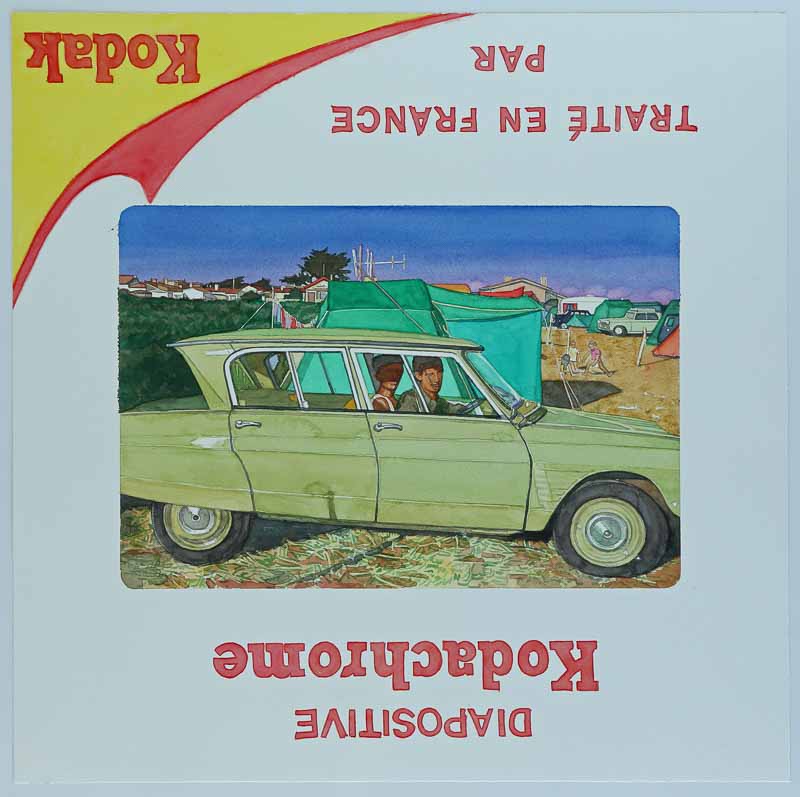
Paul Simon topped the charts in 1973 with Kodachrome, his hit single celebrating the “nice bright colors” of Kodak’s popular film for slides. Those vivid “greens of summers” may well have given us the illusion, if only for a moment, that “all the world’s a sunny day.” When contemplating Stéphane Belzère’s Diaquarelles, which entirely cover a large wall of his Parisian studio, we can feel that same intense luminosity. The title of the series is a combination of “diapositive” (slide) with “aquarelle” (watercolor). These modestly scaled works convey a sense of warmth and familiarity, no matter what the images represent. Whether we’re looking at a smiling family portrait taken at the beach under a cloudless sky, or a scene from the Sandinista Revolution in Nicaragua, our gaze is first and foremost captivated by the sparkling, saturated color.

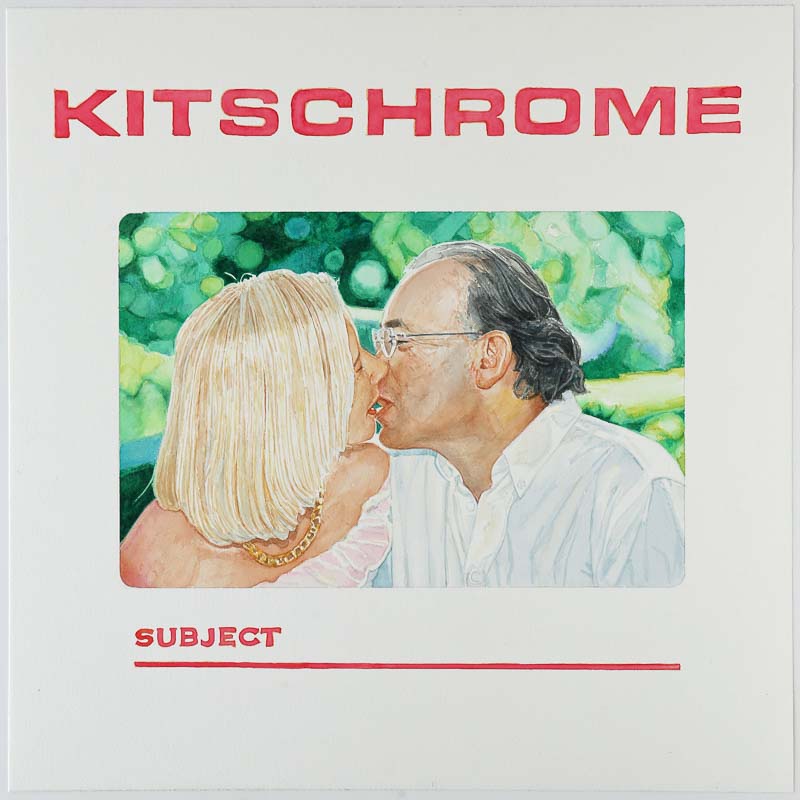
Stéphane Belzère has been working almost exclusively on his Diaquarelles since 2019. In these watercolor paintings done from slides, which have been scanned and then enlarged on a light table, he paints not only the photographic image but also the slide frames with their brand names and personal inscriptions. The square format of the paintings, which are ten times the size of the original slides, recalls the format of the slides themselves, reminding us of their history and their widespread use not that long ago. Positive images (as opposed to negatives) were already being developed on glass plates and projected using a magic lantern in the 1800’s. With the commercialization of slide film such as Kodachrome in the mid 20th century, their popularity peaked in the 1960’s and 1970’s before declining in the early 2000’s with the introduction of digital technologies. Those of us who grew up in the 1970’s may still have memories of family slide shows for viewing pictures taken over summer vacation, or of slide-lectures in school with the steady hum of the projector in the background.
What Belzère is proposing in his Diaquarelles is in fact a kind of time travel, a journey to a not-so-distant past seen through the eyes of everyone. The project got off to an accidental start when he came across a box of slides while cleaning out the apartment of an elderly relative. He initially found it touching to look at these family photos that brought back personal memories, but he was also moved by the quality of the images themselves. As amateur photographs, they capture moments of everyday life from decades ago, but sometimes rather awkwardly. As Belzère explains : “Traditional photography wasn’t so easy. These ‘private’ images that I use are often overexposed, underexposed, poorly composed... [1]” In his watercolors, he reproduces the familiar blemishes and the awkwardness of family snapshots, such as glare spots, uncomfortable poses, scowling faces and closed eyes.

Since his discovery of the first box of slides, Belzère has been on a quest to accumulate as many as he can. Family members, friends, and even some institutions with which he has connections, such as the Fine Arts School of Paris where he was a student from 1984 to 1989, and the Zoological Museum of Strasbourg, have entrusted him with entire collections. Hence the diversity of the paintings that cover the wall of his studio. Side by side we see images of vacations spent at the beach, or riding a camel across the desert in Egypt ; we see students at the Fine Arts School of Paris working from the nude model ; we see Andy Warhol, unaware that his picture is being taken, at the Fiac, the contemporary art fair in Paris ; we see the winner of the 1975 Tour de France bicycle race surrounded by an admiring crowd ; we see the Berlin wall, Agamemnon’s mask, a sunflower, a bacteria under a microscope... The scenes represented in a few of the Diaquarelles – such as farmers harvesting hay, or a canoe ride down a peaceful river, also recall paintings from art history, namely Monet’s Haystacks and Caillebotte’s Périssoires sur l’Yerres (Canoes on the Yerres). Other Diaquarelles directly refer to Belzère’s own works : Diaquarelle n° 2, for example, is painted from a slide of a face in a jar of formaldehyde that came from the Museum of Natural History in Paris, and which appears in his monumental canvas La Salle des pieces molles – Nocturne (The Cabinet of Soft Tissues – Night-time), painted on site at the Museum.

Painting remnants and ruins, drawing inspiration from that which has become obsolete is a recurrent theme in Belzère’s work. While he was still a student at the Fine Arts School in Paris, he set up his easel in the basement of the school where plaster casts of antique et neoclassical sculptures had been put into storage. Once important tools for learning how to draw and paint the human figure, these plaster copies had long since been relegated to the basement, piled one on top of the other, frozen forever in their draperies and contrapposto. In his paintings, the young artist gave these plaster figures a strange and anachronistic vitality, producing a series of works that seem to question the traditions of education in the Fine Arts and the professional status of the artist. These paintings would be shown in his first solo exhibition in 1990 at the Taylor Foundation in Paris.
A few years later, from 1995 until 2004, he set up his easel at another institution steeped in history, the Museum of Natural History in Paris, where he was authorized to paint on site from the Museum’s collections and where he produced a large body of work, the Bocaux anatomiques (Anatomical Jars), that were recently exhibited at his solo show at the Museum of Modern and Contemporary Art of Strasbourg [2]. These paintings, done in vinyl emulsion paint on canvas, represent all kinds of organic specimens preserved in a formaldehyde solution in glass jars. Richly colored and enlarged in the paintings, these remains of living creatures are transformed into landscapes of flesh that are both sensual and disturbing. The creamy blending of colors seduces our gaze while leading us to reflect upon our own fleshy corporeality.
Belzère is just as fascinated, however, with color and the transcription of its transparency as he is with those “soft tissues” floating in their jars. This fascination led to the series of over seven hundred small self-portraits that he made at about the same time, from 1995 until 2013, working from his reflection in the window of his studio at night. Contemplating his image in the windowpane, he carefully observed his face and body intermingled with shadows and city lights, as if he himself had become the specimen in a jar and the object of study for painting. In the early 2000’s, his mastery of light, color and transparency reached its culmination in a project that he proposed for the stained-glass windows of the Rodez Cathedral, brilliantly bringing together all his pictorial interests. Made between 2003 and 2007, the windows revisit Christian iconography by incorporating images drawn from human and animal anatomy. Fragments of organic matter appear suspended in a light-infused environment that’s both aquatic and celestial, creating an audacious and personal interpretation of the incarnation and the transfiguration of Christ.
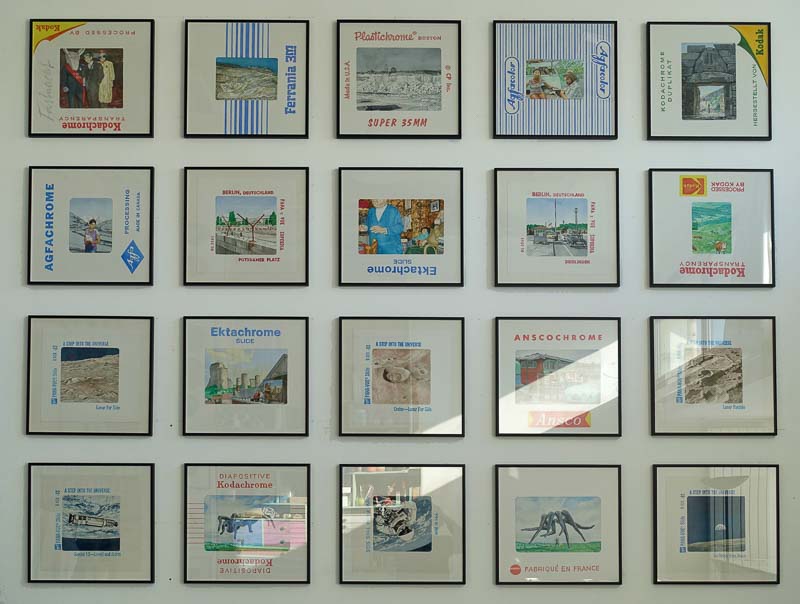
Today, Belzère is pursuing his exploration of color and light in the ongoing series of Diaquarelles. It’s with this new series of paintings that he began using watercolors, the transparency of the diluted colors and the bright white of the paper being ideal for evoking the luminosity of projected slides. To perfect his technique, he’s made several color charts, some of which are also hanging in his studio like artworks in of themselves. They represent many shades and variations of primary and complementary colors, organized in perfectly aligned rows, reminding us of the seductive, rainbow-like presentations of tubes of paint in art supply stores. They might also recall the minimalist grid turned into a feast for the eyes, or an experiment in geometric abstraction born of a fascination for color and the pleasure of painting.
It’s therefore no coincidence that Stéphane Belzère’s very first Diaquarelle can be seen as a tribute to painting. It represents a Kodachrome slide of a painter working outdoors who looks somewhat like Monet with his long beard and cap. His easel is set up on a riverbank where he’s painting a watercolor of a fortified castle on the opposite bank. Belzère clearly enjoyed painting a kind of mirror image of his own artistic practice : he’s made a painting of a painter at work, but with a nod to his family history. As the only son of two painters, Jürg Kreienbühl and Suzanne Lopata, both of whom were deeply attached to certain traditions of figurative painting and who worked exclusively from life, he was absolutely forbidden to paint from photographs when he was a young artist learning his craft – a rather strange taboo for a family living just outside of Paris in Cormeilles-en-Parisis, the birthplace of Louis Daguerre. Although Stéphane has long since broken with his family’s tradition, it’s with affection and probably with a bit of malicious pleasure that in another Diaquarelle, the n°9, he painted a Kodachrome slide of his father seated outdoors painting a landscape.

Painting from photographs, or from images found on the Internet, has now become so commonplace that many art critics feel the need to point out the differences – and they’re right to do so – between “paintings” and “Images” [3]. The Diaquarelles clearly demonstrate with sensitivity and humor that photographs can provide rich and nearly inexhaustible source material for painting, while underscoring the fact that a photograph can only be a starting point for producing a work of art. We should also point out that the Diaquarelles are not photorealistic paintings. The artist’s hand is too apparent. We can feel its presence in the touch of the paintbrush, or in the way that one color discretely bleeds into another. Stéphane Belzère uses color to reconstruct a world from images that appear familiar to us, and which constitute our collective imagination. Time-bound by their frames, these images captivate our gaze and draw it towards another era. We’re enchanted by these sparkling blues and greens, these “nice bright colors” that rekindle our memories, whether they’re real or imagined, leading us to think, if only for an instant, that “all the world’s a sunny day.” So mama, don’t ta-a-a-ake my Kodachrome away...
May 2025
Notes
[1] Interview with Estelle Pietrzyk and Anna Millers, in cat. Mondes Flottants, Stéphane Belzère, Musée d’Art moderne et contemporain de Strasbourg, 2022, p. 50.
[2] Mondes Flottants, Stéphane Belzère, Musée d’Art moderne et contemporain de Strasbourg, December 3 to August 27, 2023.
[3] See for example “The Gazes of Painting” by Romain Mathieu, Artpress, n° 509, April 2023, p. 52-54.


Diaquarelles, Stéphane Belzère
Galerie LÀ
l’art contemporain à la campagne
54 Grand rue Paul saint Martin à Simorre (Gers)
from July 10 to August 31st 2025
tuesday to saturday 10h-19h, sunday 10h-12h,
and "sur RDV" Jacques Barbier 06 73 95 74 69 ou Elise Pic 06 26 82 23 34
Photo Basel, galerie XII, June 17th to 22nd 2025, Basel-CH