Accueil > Les rubriques > Images > SUITE : To be continued…
SUITE : To be continued…
drawings by Romy Muijrers and Paul van der Eerden
, , et
Toutes les versions de cet article : [English] [français]
Since 2018, Romy Muijrers and Paul van der Eerden have been working together on their SUITE project, an ongoing series of intimately scaled drawings, mostly done in pencil, colored pencil and an occasional touch of gouache. The project got off to an accidental start when Paul handed Romy a drawing that he’d begun and asked her to finish it, entirely as she wanted. This initial four-handed drawing was interesting enough to make them want to experiment further.
Today there are over 200 drawings in the series by Romy Muijrers and Paul van der Eerden, several of which have been exhibited, namely at the Maurits van de Laar Gallery in The Hague, and at the Kunstmuseum in Bochum, Germany. Looking at the rich graphic diversity of these collaborative works, they appear to us as an encyclopedic testimony to the endless possibilities of line, color and composition, a celebration of the process of drawing.
Before they met, and regardless of their difference in age, it could be said that Romy Muijrers (1990) and Paul van der Eerden (1954) were already kindred spirits. Not only are they both unequivocally devoted to and passionate about drawing, but the way in which each artist combines different drawing materials to structure, compartmentalize or saturate the space of the paper invites comparison. Prior to their meeting, Muijrers’ drawings could be described as sensual, labyrinthic landscapes in which desire and emotion find expression through the tumultuous interplay of line, texture, shape and shadow. Using only a graphite pencil and a colored pencil – often pink or a flesh tone – she obtains a full range of tonalities and creates multiple spaces that suggest perpetual movement, as if the different parts of the drawing were constantly readjusting themselves. Figurative imagery, body parts, musical notes and fragments of text are woven into these complex compositions, leading perhaps to the unfolding of a narrative in the viewer’s imagination.
It has been written that Muijrers has an obsessive way of working, spending a lot of time on her drawings and “losing herself” in the process. [1] This has led her to push the boundaries of drawing beyond the sheet of paper by adding elements of collage and by drawing on to the surrounding space of the wall. In comparison, Paul van der Eerden’s work has a more controlled and crisp appearance. He has stated time and again that he does not work from ideas, but certain images or themes do reappear consistently in his work, such as schematic body parts that are stacked or arranged to create geometric motifs, repeating faces with wide-open eyes and gaping mouths, and splay-legged women or figures that are engaging in some form of sexual activity. Cartoonish and brutal, his drawings explore the full range of human emotions and behaviors. And yet, his finely crafted works on paper resonate with jewel-like perfection. There appears to be no line out of place, no color or contour that looks incongruous or accidental. Small in scale, the drawings beckon the eye closer, arresting the gaze with their full range of textures, from the glistening intensity of densely overlaid graphite to the veiled haziness of delicately nuanced tones in colored pencil.
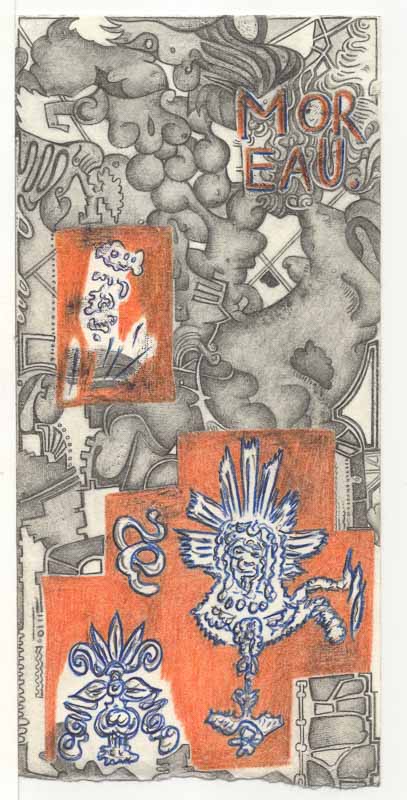
Looking attentively at the drawings from the SUITE project, the presence of each artist’s hand can be seen and felt in most of them. Muijrers’ graphite smudges and sensuous modelling of grey tones both fuse and contrast with Van der Eerden’s outlines and raw, stylized imagery. There are no rules for guiding the process of making these drawings. Densely packed kaleidoscopic compositions made up of interlocking shapes, body parts and cartoon-like motifs alternate with works that appear more “recognizable”, suggesting figures, portraits or landscapes. References to other artists abound, namely Maria Lassnig and Philip Guston, and certain drawings openly pay tribute to art history, revisiting works by Arcimboldo, Moreau, Victor Hugo, Picasso, Léger and De Chirico. Fragments of text are worked into several drawings, the visual impact of the drawn letters and words becoming an integral part of the composition. Both artists draw inspiration from literature and poetry, and Muijrers has mentioned the importance of the Oulipo group, l’Ouvroir de littérature potentielle founded by Raymond Queneau, for her work. The use of self-imposed constraints for the choice of text, or for the rearranging of passages from a favorite literary work, might resonate with the emotion of the day and set into motion the creative process.
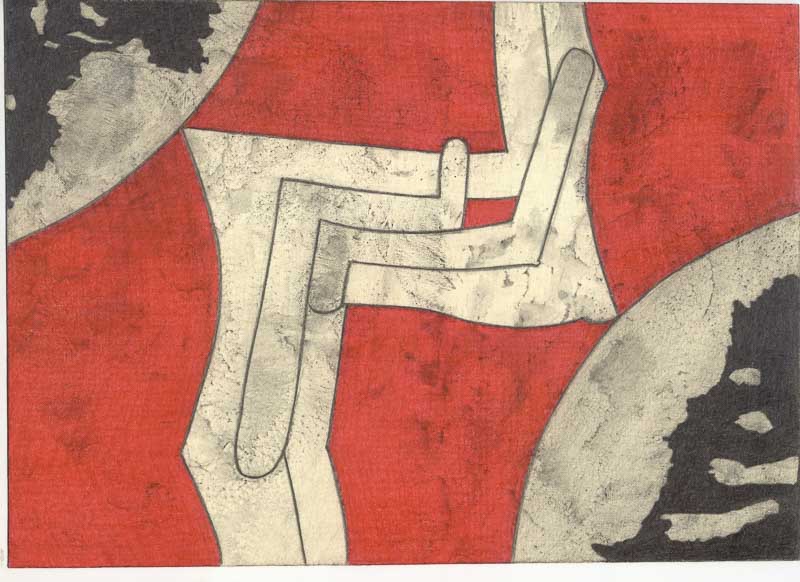
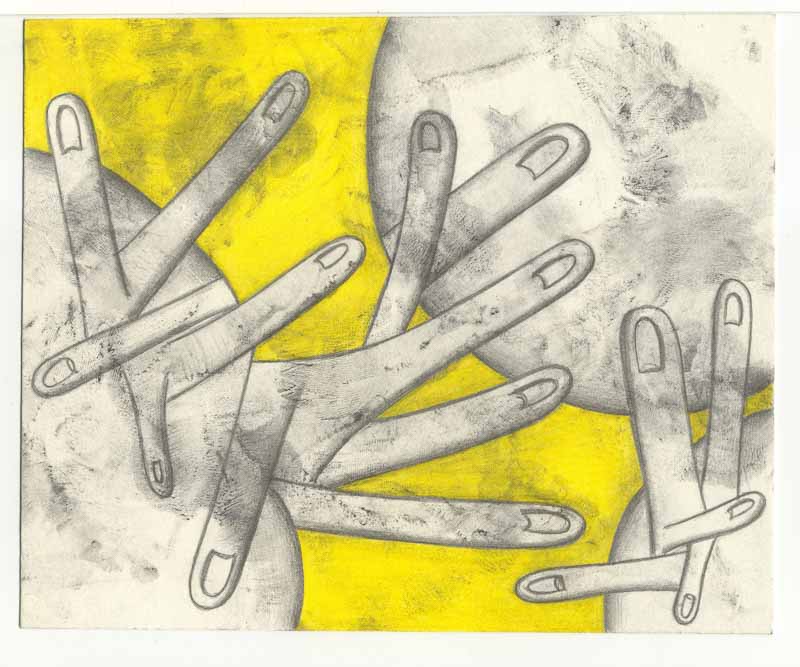
A drawing can be started or finished by either artist. Muijrers might begin by rubbing spots of graphite into the paper, around which Van der Eerden will then draw contours, or on the contrary, Van der Eerden might start a drawing by outlining a figure, which Muijrers will then transform and perhaps integrate into an elaborate, fictional landscape. The drawing could get passed back and forth several times, be rotated or turned upside down, be partially erased or have areas of color added to it. Sometimes, following a discussion, a drawing is made by only one artist. The presence of hands and fingers in several of the drawings, such as in SUITE 009 and again in SUITE 064, in which interlocking fingers connect what appear to be two opposing planets, or two artistic worlds, could be seen as testimony to both the collaborative nature of the project and the profound complicity between the two artists. The drawn hands and fingers could also allude to the notion of drawing as concept, the thinking hand taking the pencil on a journey across the paper’s surface.
While there are many well-known artist “teams” and collectives spanning art history, from the famous collaboration between Rubens and Brueghel in the early 17th century up to the many artist couples and collectives working today, the originality of the SUITE project resides in the capacity of both artists to remain consistently inventive, thus allowing the SUITE to become an evolving entity with a life of its own. Both artists still maintain their individual practices, but they are in constant communication, visiting exhibitions and museum collections together, producing notes, diagrams and sketches that lead to the creation of drawings.
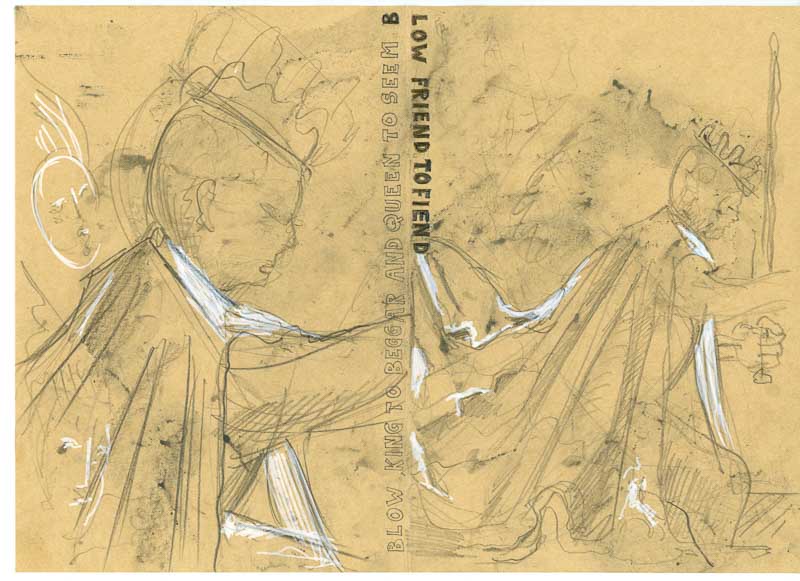
Most recently, in a series called SUITE : CUT-UPS, they’ve adapted an Oulipo technique as a way of taking a more experimental approach to drawing. Upon a sheet of paper smeared with graphite that he receives from Muijrers, Van der Eerden will make a loose pencil drawing inspired from a painting that they’ve both seen – a work by Fuseli, Ensor, Munch or Grünwald, to name only a few – ; Van der Eerden will then show what he drew to Muijrers, who associates it with a poem by e.e. cummings ; Van der Eerden will then select or rearrange the lines of poetry and integrate them into the drawing. Quick and scribbly in appearance, these works usher in a new direction for the SUITE project. CUT-UPS refers not only to the rearranged poems, but also to the drawings. Van der Eerden has divided the paper in half, on one side making a drawing from a work of art, and on the other making a detail, or an enlargement from his own drawing. These close-ups, which aren’t recognizable as such at first, appear as separate drawings, and yet in combination with the text, the paired images could suggest a fragment from an unfinished comic strip, inviting the viewer to imagine the unraveling of events.
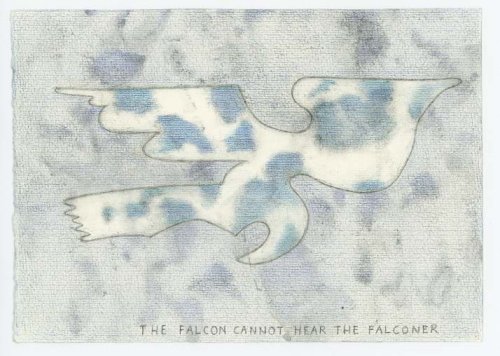
In another recent SUITE series, Muijrers and Van der Eerden responded to an invitation from the Kunsthal KAdE in Amersfoort, Netherlands, by producing about one hundred drawings for Miraculous Beings [2], an exhibition celebrating animals and inspired by a text attributed to Aristotle, De Mirabilibus Auscultationibus (On Marvellous Things Heard). Composed of several “hearsay” observations of animals and natural phenomena, such as : “Among the Indians in the part called Keras, they say that there are small fish which wander about on dry land, and then run back again to the river,” the ancient text has been a rich source of inspiration for artists, leading to fantastical depictions of creatures both real or imagined. The “zoological” SUITE drawings created from Muijrers’ subtle shading and Van der Eerden’s decisive contours – for example, the celestial FALCON, or the expressive and anthropomorphic HYENA – might lead us to contemplate our profound resemblance to these Miraculous Beings.
The exchange between Muijrers and Van der Eerden is like a visual conversation, an epistolary drawing project in which each artist responds to what the other has done in a way that continuously explores the process of creating a shared mental space with tools as rudimentary as a graphite stick and a colored pencil. As viewers who’ve been following the evolution of the SUITE project, plunging our gaze into these enigmatic thoughtscapes to seek out our own fantasies and desires, we might wish that we could also partake in the conversation and ask the artists : Dear Romy, Dear Paul, what’s next ?
Opening image : SUITE 009, pencil, colored pencil and felt-tip marker, 21 x 29,7 cm, 2018.
Notes
[1] Alex de Vries for Mister Motley, 2017.
[2] Wonderbaarlijke Wezens, June 3rd to September 3rd, 2023.


