Accueil > Les rubriques > Entretiens > Infinite resonance
Infinite resonance
Zimoun, dialogue Between Order, Chaos, and the Void
,
Toutes les versions de cet article : [English] [français]
"Docufiction interview"
"…And words detach from things, and things from beings, as they carefully fixate on the resonance at the edges of the worlds."
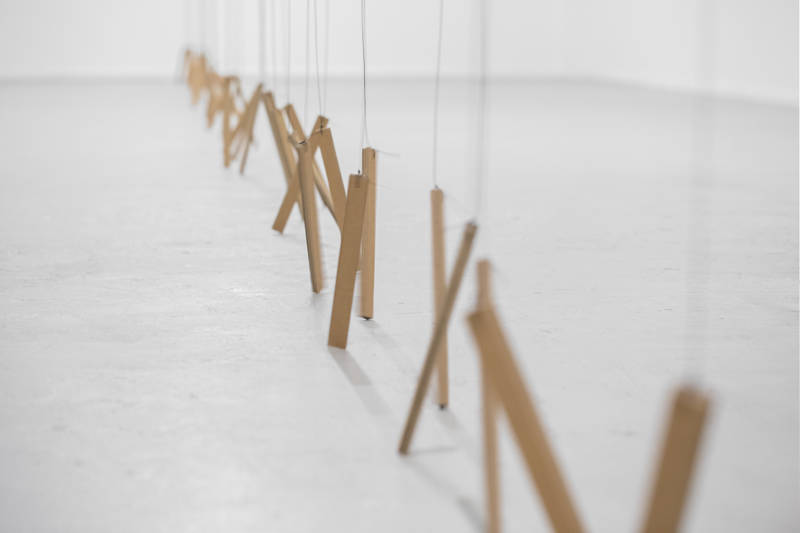
Along the luminous line that crosses life, between death and a possible reincarnation, as in a dream, Order, Chaos, and the Void stand side by side, exchanging their impressions of the work of the artist Zimoun. A renowned Swiss artist known for his site-specific installations made from recycled industrial materials, Zimoun uses simple mechanical principles like rotation and oscillation to set objects in motion, generating sounds. His works, often described as sound architectures, explore tonal and visual complexity through rudimentary mechanisms, without his direct intervention in their sonic evolution.
His art seems an extension of himself, projecting a dialogue between order and chaos. This undefined place, suspended between space and time, resembles a vast exhibition hall filled with a thick, palpable silence — like a subtle darkness permeating every corner. The darkness is not complete, but the outlines of visitors fade, blending into the thick shadows, erasing the boundary between bodies and the surrounding space.
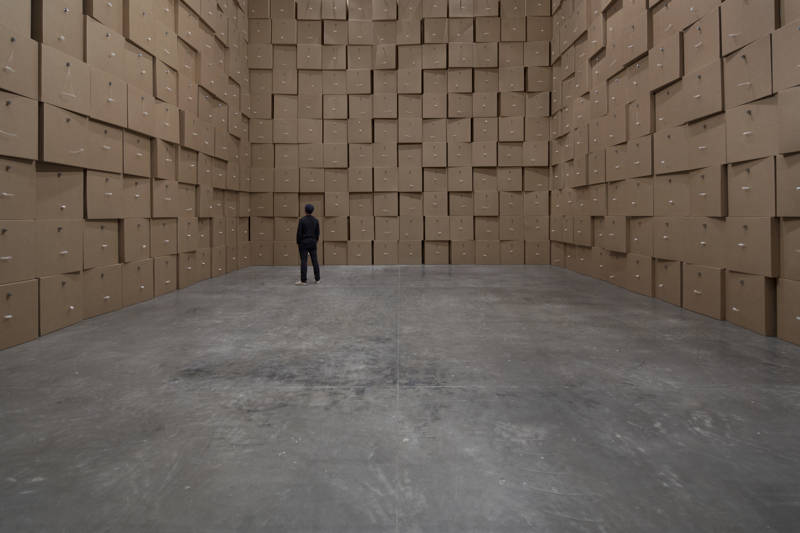
Le 104, Paris
Photography by Zimoun
At the center of the room, an imposing mechanical installation casts undulating shadows on cardboard boxes, though it has yet to produce sound. Time feels frozen, suspended, as if awaiting a storm. Under this silent dome, two figures enter the space simultaneously. Order, a young woman with radiant blue eyes, moves slowly, attuned to every subtle vibration. Behind her, Chaos, a man with dark, curly hair and a face marked by anxiety, scans the space warily. They do not know each other, but their presences resonate like two dissonant notes on the verge of collision.
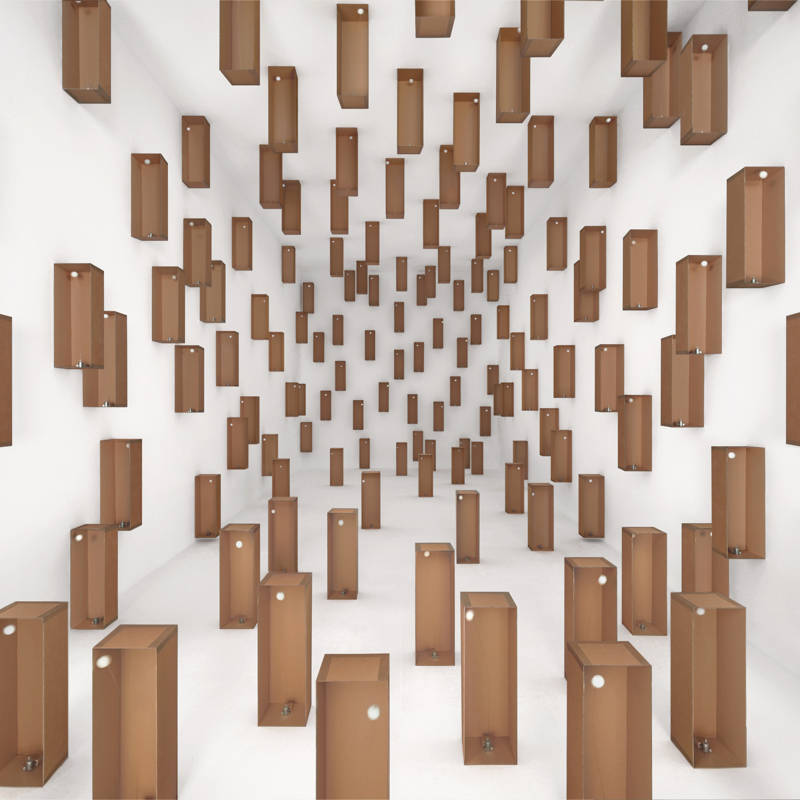
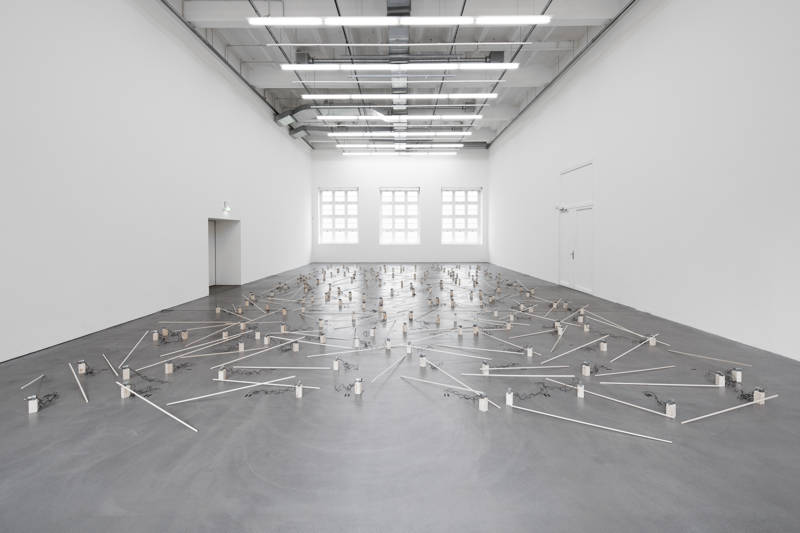
Dimensions : 12m x L.imx Lim.
Installation view : private collection.
Photography by Zimoun
A metallic clink suddenly breaks the silence. A machine awakens, a discreet motor activating an arm that scrapes a suspended metal plate. The sound, barely audible at first, softly reverberates through the space like an invisible wave. Order feels the vibration in her chest, a pulse that echoes her heartbeat. Each breath from the metal transports her into an intangible space, where her thoughts and sensations are enveloped by the continuous hum. The steady scraping of metal on cardboard seems to connect her to a deep pulse of the universe.
Zimoun : Compilation Video 4.3 (2024) : Sound Sculptures & Installations
For Chaos, however, every vibration feels like an assault. The mechanical beating evokes an infernal clock in a room too small. Under the pressure of the sound, his temples tighten. He no longer just hears the noise ; he suffers from it, like a sonic poison infiltrating every corner of his mind. The chiaroscuro around him does not soothe but instead dissolves the space’s contours, amplifying his dismay.
The sound grows more complex. Other mechanisms join the muffled metallic echo. The Void, a translucent, shapeless mass—gelatinous and in perpetual motion—detaches itself from the group. A series of rhythmic wingbeats arise, creating a soundscape that mirrors the visitors’ breathing and heartbeats. Without realizing it, their breaths synchronize with the rhythm imposed by the installation.
Then, fleetingly, the artist’s silhouette appears.
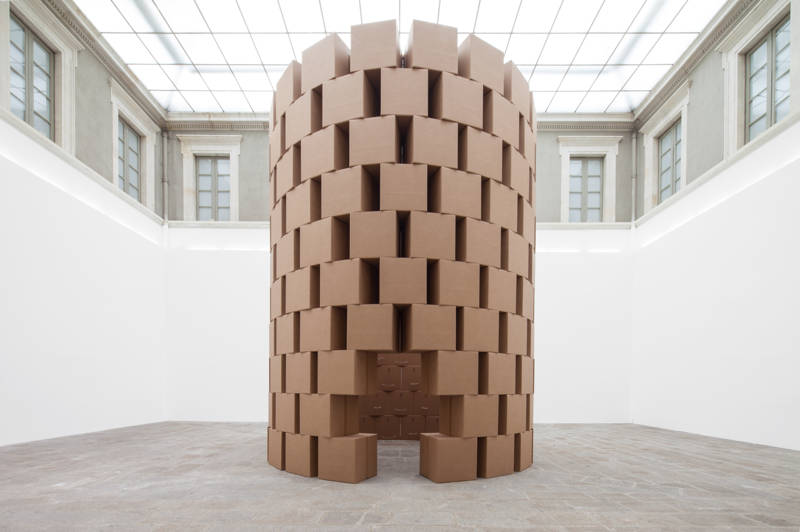
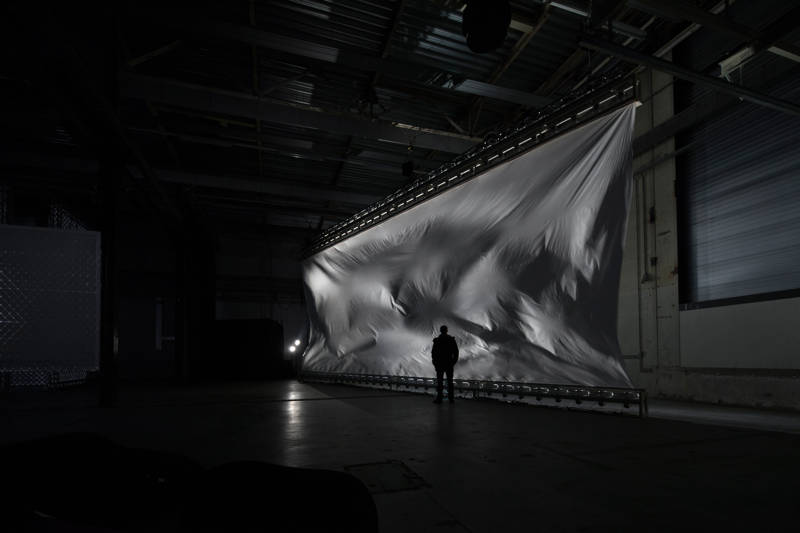
Musée des Beaux-Arts Rennes, France.
Photography by Zimoun
The Void : "In your sound installations, how do you conceptualize the relationship between the repetitive rhythms of your mechanical sculptural objects and their influence on our perception of space ? In your view, how do these sounds impact our orientation, emotions, and immersion in a given environment ?"
Zimoun : "Spectators experience my installations in very subjective ways. Some feel a deep sense of calm and want to stay for hours, while others feel anxious and rush to leave. These reactions often reveal more about the individual than about the work itself. This is probably true for any sensory experience since we shape our perceptions and, by extension, our subjective realities.
For me, the experience of the work and the space are so intimately intertwined that they become one. Sound allows us to perceive space beyond the visual. The textures, proportions, and materials influence the sounds produced. These sounds reflect off the architecture or are absorbed, generating unique acoustic effects. In this sense, sound becomes the space—or at least profoundly shapes how we perceive it."
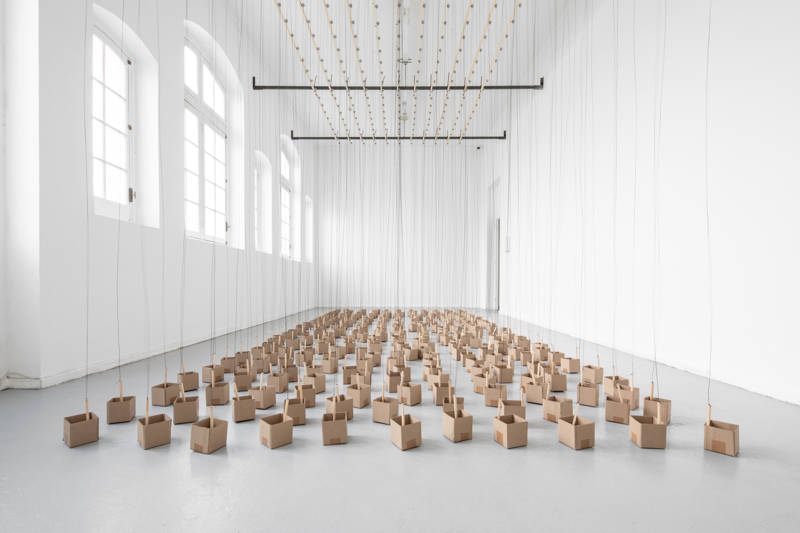
Dimensions : variables.
Museum of Contemporary Art MAC Santiago de Chile.
Photography by Zimoun
Zimoun’s specter, a visitor in this dream, journeys within the bodies of those present.
In her mind, Order perceives the sound taking shape. Suddenly, she finds herself in a vast meadow, surrounded by an invisible swarm of bees. Each wingbeat produces a gentle wave, a vibration caressing the air. It is as if the machine and nature have merged into one. She feels at peace, soothed by this harmony. The bees communicate with her, not through words but through their rhythmic wings. Their buzzing, at 250 Hz, resonates with the installation’s mechanisms. Time dissolves, everything stands still, and the work becomes a vessel for this orchestration of whispers.
For him, Chaos, the same sound turns into a sensory nightmare. The bees’ buzzing becomes an oppressive threat. He does not see the meadow, only invisible insects closing in on his mind. Every vibration intensifies his panic. He imagines these tiny creatures poised to invade him, their vibrating wings feeding his growing anxiety. The sound does not speak to him—it attacks. He covers his ears, but the vibrations seem to come from within. He implodes...
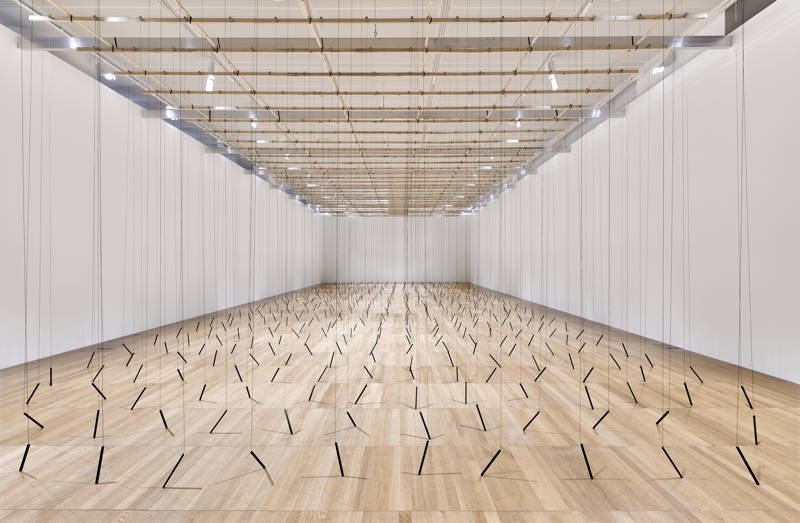
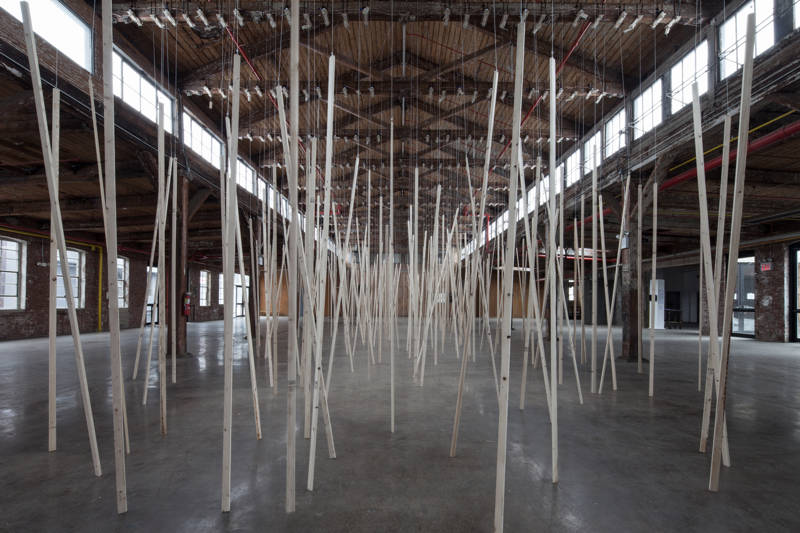
Installation View : NYUAD Art Gallery, Abu Dhab i Courtesy : The NYU Abu Dhabi Art Gallery, photo by John Varghese
The Void : "Your creations can be arranged in geometric patterns or an ordered system, but they behave chaotically, acting randomly within a carefully prepared framework once they are mechanically activated. Your work often explores the resonance between sound, space, and materials. Have you considered how non-human organisms, such as insects or animals, might perceive these repetitive sound environments ?"
Zimoun : "Given how complex sound perception is for humans, it’s even harder to know how other life forms experience these sound environments. However, my works often evoke movements of nature, despite being created from purely artificial systems. I find it fascinating that simple structures, like a motor activating a material, can elicit such complex reactions from viewers. This exploration of complexity through simplicity raises questions about human perception. Is complexity measurable, or is it simply a difficulty in comprehending a system in its globality ?"
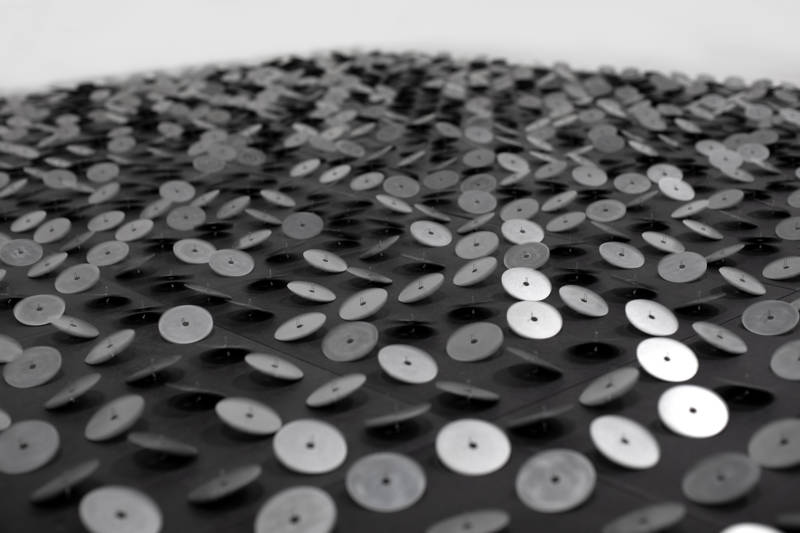
Installation view : Warehouse Jaeger-LeCoultre, Geneva, Switzerland. This installation was commissioned by Jaeger-LeCoultre and produced in collaboration with Tetro. Photography by Zimoun
Redefining space beyond individual and collective perceptions.
When space interacts with sound, waves diffuse and bounce off walls, creating almost imperceptible echoes, like the hum of bees in a hive. The entire space becomes a vast instrument, modulated not only by the mechanisms but also by the visitors’ heartbeats, breaths and thoughts. Each moment is an interaction between the installation, architecture and humans, where each element influences and transforms the other, forging a subjective, fluid and shared reality.
Integrating sound architecture into urban environments could offer animal species, like birds, a chance to adapt by mimicking their natural sound patterns. A symbiosis where the artificial and the natural, architecture and ecology, merge.
Order suddenly opens her eyes. Far from fading, the vibrations intensify. But rather than disturb her, they amplify a deep sense of connection between the natural and the artificial. In a trance-like state, she moves slowly, as if guided by an invisible architecture orchestrating her steps. Sound is no longer a mere wave but a palpable material penetrating her bones, resonating with an ancient, almost animal, memory.
On the other side of the room, Chaos can take no more. Claustrophobia seizes him violently. The hum, once discreet, has turned into a deafening roar, suffocating his breath. What soothes her, oppresses him. His exhausted body trembles under the accumulated tension. He desperately searches for an exit. But there is none.
The sonic experience, which alters and influences the body’s vibrations, reveals a truth that transcends fiction. The mechanical sounds of Zimoun’s works, though artificially produced, involuntarily mimic the communication, defense, and self-regulation patterns of living organisms—bees, termites, bats. Immersed in this space, the visitor becomes like them : part of a vast shelter, an organic den, a place where flows cross and intertwine.
Three gigantic figures loom over Zimoun.
The Void : "You may cross to the other side."
The ethereal silhouette of the artist steps through the threshold.
In a dazzlingly bright corridor, he is met with ovation from his peers—La Monte Young, Pauline Oliveros, Iannis Xenakis, David Dunn, Bernie Krause, and Ryoji Ikeda. All share a common fascination : the subtle interaction between sound, nature and technology. They stand at the intersection of art and science, where Nature and Artifice are no longer opposed but merge into a singular, organic whole.
The idea that mechanical sounds can reproduce natural patterns, creating flows that affect both the body and space, urges us to reconsider our place in the world. We are part of a global sound ecosystem, where every vibration matters. In Zimoun’s works, the boundary between the living and the machine becomes porous, almost indiscernible. Algorithms and mechanical structures blend with biological patterns, revealing that insects, animals, natural flows, and technologies all operate under the influence of fundamental vibrations. These vibrations are the hidden heartbeat of the Earth, synchronizing all life processes, from the microscopic to the geophysical.
A flash of light.
A bright glow crosses the space. Zimoun splits, multiplies, like his own works. He becomes an infinite mise en abyme, absorbed by the boundless space of the universe’s museum at the edges of worlds, where time fades, and matter and sound fuse.
Zimoun’s sound architectures have found their place in the symphony of worlds, resonating endlessly in the Earth’s vibrant echo, where posterity marks every vibration.